CrossFit Journal KDP Interior Template: A Practical Guide to Creating Your Own Fitness Journal
If you’ve been exploring low-content publishing on Amazon KDP, you’ve likely noticed that fitness journals are a popular category. Among them, a dedicated CrossFit journal holds appeal for athletes and coaches who want to track workouts, log progress, and stay organized. Instead of starting from scratch, many creators turn to a ready-made solution like the CrossFit Journal KDP Interior Template. This resource provides a structured layout designed specifically for CrossFit training logs, saving you design time while giving you a professional-looking interior. But is it the right choice for your project? This article walks through what this template offers, how it compares to other approaches, and what to consider before making a decision.
What Makes the CrossFit Journal KDP Interior Template Distinct?
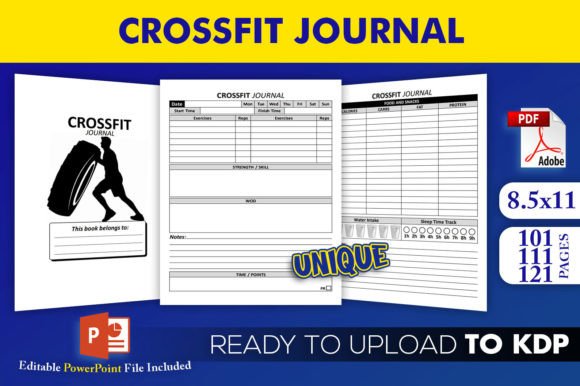
At its core, the template is a set of files that form the interior pages of a CrossFit-themed journal. It typically comes in an editable PowerPoint (PPTX) format, along with three PDF versions ready for upload to KDP—each with a different page count (101, 111, and 121 pages). The trim size is 8.5x11 inches with no bleed, which is a standard choice for spiral-bound or paperback journals. The interiors are high-resolution, so text and graphics remain crisp when printed.
What sets this template apart from a generic workout log is its focus on CrossFit-specific metrics. You’ll find sections for WOD (Workout of the Day) tracking, reps, sets, weights, and even notes on scaling. The layout is clean and functional, not overly decorative. For someone looking to publish a niche journal, having these tailored prompts already in place saves a lot of guesswork. The included editable source file means you can adjust fonts, add your own branding, or tweak the wording to suit your audience.
Another distinct advantage is the testing claim: “files has been tested on KDP.” This suggests the formatting complies with Amazon’s upload requirements, which can be a tricky area for beginners. Getting the margins, bleeds, and page counts right is critical, and a pre-tested template reduces the risk of rejection.
Comparing Approaches: Template vs. Custom Design vs. DIY
When deciding how to produce your CrossFit journal, you generally have three paths: use a pre-made template like the CrossFit Journal KDP Interior Template, hire a designer for a custom interior, or build everything yourself from scratch using software like Adobe InDesign, Canva, or even Word. Each has its own balance of cost, effort, and control.
Pre-Made Template
This is the middle ground. You get a professional structure without the high price of custom design. The template is ready to use out of the box, and because it’s been tested on KDP, you avoid common upload pitfalls. The tradeoff is that you have limited uniqueness—many other publishers might use the same template. However, you can customize the editable PowerPoint file to add your logo, change colors, or rewrite section headers. That’s enough to differentiate your journal if you invest a little effort.
Custom Design
Hiring a designer gives you a one-of-a-kind layout tailored exactly to your vision. You can request specific page flows, unique graphics, and precise formatting. The downside is cost—professional design can range from hundreds to thousands of dollars depending on complexity and revisions. You also need to communicate clearly, and the timeline can be weeks. For someone just starting or testing the market, custom design may be overkill.
DIY from Scratch
If you have design skills and patience, creating your own interior gives you full control. You can make it as minimalist or elaborate as you want. But this approach often leads to hidden time costs: learning software, adjusting margins, ensuring consistent spacing, and troubleshooting KDP upload errors. Many independent publishers find that a template gives them a faster, more reliable result with less frustration.
Strengths and Tradeoffs of Using a Pre-Made Template
Every choice has strengths and limitations. Let’s look at what the CrossFit Journal KDP Interior Template does well, and where you might feel constrained.
Strengths:
- Time savings: Instead of designing each page, you can edit the template in PowerPoint and export. The three PDF options (101, 111, 121 pages) also let you choose a length that fits your content plan without recalculating page counts.
- KDP-ready formatting: The no-bleed 8.5x11 trim is straightforward for print-on-demand. The tested claim suggests the files meet KDP’s specs, which gives peace of mind.
- High-resolution interiors: Professional-looking text and graphics reduce the amateur feel that some self-published books suffer from.
- Customizable core: The editable PPTX file allows you to personalize headers, add your brand, or insert your own instructions for users.
Tradeoffs:
- Limited uniqueness: Because the template is sold to multiple people, your interior will share similarities with others. You can mitigate this with distinct cover design and minor interior tweaks, but the overall structure won’t be exclusive.
- PowerPoint dependency: Not everyone is comfortable editing in PowerPoint. Using a template often requires at least basic knowledge of the software, and some users may find the learning curve steeper than expected if they need to rearrange entire sections.
- Fixed page counts: While having three options is helpful, you can’t arbitrarily add or remove pages without disrupting the formatting. If you want an exact page count not offered, you may need to adapt the template or combine pages creatively.
Best-Fit Situations: When This Template Shines
The CrossFit Journal KDP Interior Template works particularly well for specific scenarios. If you’re a fitness coach who wants to offer a branded journal to clients, the editable PPTX lets you add your gym logo and contact info quickly. You can produce a batch for your athletes or sell on KDP as an additional revenue stream.
For first-time KDP publishers, the tested files reduce technical barriers. You can focus on crafting a compelling product description and cover design rather than wrestling with margins. The three page counts give you flexibility to test different price points or formats—for example, a shorter 101-page version as an entry product and a 121-page version for more committed users.
If you’re creating a series of fitness journals and want a consistent interior style, this template can serve as a base. You can reuse the editable file across multiple titles, adjusting the content to cover different training focuses (e.g., strength cycles, Olympic lifting, or general conditioning). The high-resolution elements also scale well for other paperback sizes if you adapt the file, though that would require additional formatting.
When You Might Need a Different Solution
No template is universal. If your vision includes a highly specialized layout—for instance, a journal that breaks down each movement with space for video references, or a hybrid planner that includes nutrition tracking alongside WOD logs—you may find the template’s structure too rigid. In that case, custom design or a more flexible DIY approach would serve you better.
Similarly, if you want a spiral-bound interior that bleeds to the edge with full-color graphics, the no-bleed 8.5x11 format may not meet your needs. This template is designed for budget printing and standard paperback or coil binding. For premium finishes, you might need a bleed version or a different trim size.
Publishers aiming for a very specific aesthetic (e.g., vintage paper backgrounds, unique typography throughout, or hand-drawn illustrations) will likely find a template too generic. The value of a template lies in efficiency, not in artistic originality. If your brand depends on a unique visual identity, investing in custom design is worth considering.
Practical Decision Factors to Consider
Before committing to the CrossFit Journal KDP Interior Template, weigh these factors against your own situation:
- Your skill level: Are you comfortable editing a PowerPoint file and exporting to PDF? If not, look at video tutorials or consider a template that comes in a format you already know.
- Your budget: Templates are typically affordable, often under $20. Compare that to custom design costs. For many, the template is an excellent middle option that doesn’t sacrifice quality.
- Your timeline: If you need to publish within days, a pre-made, tested template is your best bet. Custom design or DIY can take weeks.
- Your target audience: Are you aiming at CrossFit athletes specifically, or a broader fitness crowd? If the latter, a general workout log template might be more flexible. The CrossFit Journal template is designed for CrossFit’s vocabulary and common workout structures.
- Your need for differentiation: Consider your cover design, book description, and any unique bonus content you can add (e.g., a link to a mobile companion app or blank pages for notes). These elements can make your journal feel distinct even with a shared interior template.
Making Your CrossFit Journal Stand Out
Regardless of the interior template you choose, success in the KDP marketplace often comes down to presentation and usefulness. With the CrossFit Journal KDP Interior Template, you have a solid foundation. To differentiate, spend time on the cover—use striking, original imagery that reflects the CrossFit ethos. Write a clear, benefit-driven product description that explains exactly how the journal helps users log their progress.
Inside, consider adding a brief usage guide at the beginning, explaining how to track each section. Even small customizations in the editable PowerPoint file—like renaming “Notes” to “Coach’s Corner” or adding a motivational quote on each page divider—can make the journal feel more personal. The page count variation gives you room to include extras: a glossary of CrossFit terms in the 121-page version, for instance, or blank graph pages in the 111-page version for charting lifts over time.
Keep in mind that CrossFit athletes are often detail-oriented. They want space to record weights, times, and reps, but also room for reflections on technique and recovery. A template that balances structure with open-ended sections tends to receive better reviews. The CrossFit Journal KDP Interior Template usually offers this balance, but check the sample pages to ensure the prompts align with your audience’s habits.
Final Thoughts on Choosing Your Interior
Your choice of interior template can shape how readers experience your journal. The CrossFit Journal KDP Interior Template offers a tested, practical path for getting a professional product to market without a steep learning curve. It’s not a one-size-fits-all solution, but for many independent publishers, coaches, and fitness enthusiasts, it provides the right mix of convenience and customization.
If you value speed, KDP compatibility, and a layout that speaks directly to CrossFitters, this template is a strong option. If you need a fully bespoke design or plan to incorporate complex features, other routes may serve you better. The key is to match your project’s requirements with what the template offers—and to invest the time needed to personalize the final product so it resonates with your target readers.