Summer Word Search Puzzles: Practical Tools for Educators, Parents, and Homeschoolers
Keeping young minds engaged during the summer months presents a recurring challenge for anyone responsible for children's learning. Between camp schedules, travel, and the natural pull of outdoor play, structured educational time often gets squeezed. Summer word search puzzles offer a low-friction solution that fits into existing routines without demanding elaborate setup or constant supervision. For educators planning end-of-year activities, parents managing summer schedules, and homeschoolers maintaining continuity, these printable worksheets serve as a reliable resource that balances fun with cognitive reinforcement.
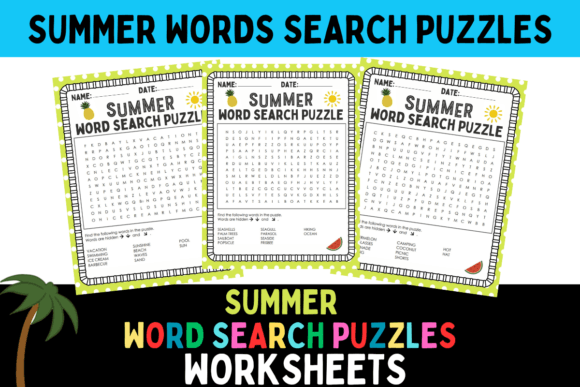
A well-designed set of summer word search puzzles does more than fill time. It builds vocabulary, reinforces spelling patterns, improves visual scanning skills, and introduces themed terminology related to seasons, holidays, nature, and outdoor activities. When packaged as a ready-to-print PDF with 15 worksheets, each sized at a standard 8.5 by 11 inches, the resource becomes immediately usable across multiple contexts. No special software, no internet dependency during use, and no preparation beyond clicking print. That simplicity is precisely what makes it valuable for busy adults who need dependable educational materials.
Where Summer Word Search Puzzles Fit in a Broader Learning Process
Effective summer learning rarely relies on a single resource. Most parents and educators combine multiple approaches: reading lists, hands-on projects, outdoor exploration, and structured worksheets. Summer word search puzzles sit comfortably in the reinforcement and review stage of this cycle. They work well after introducing a topic, before transitioning to a new activity, or as a warm-up exercise that activates prior knowledge.
Consider a typical homeschool morning. A child reads a short passage about ocean life, then completes a word search featuring marine animals. The puzzle reinforces the vocabulary encountered during reading, solidifies spelling, and provides a quiet transition to the next subject. For classroom teachers wrapping up the school year, these puzzles serve as a low-stakes assessment tool. Students who quickly locate words like "sunshine," "camping," or "barbecue" likely have a solid grasp of seasonal vocabulary. Those who struggle may benefit from additional exposure.
In after-school programs or summer camps, word search puzzles occupy a sweet spot between structured learning and free play. They can be offered as a choice activity during downtime, used as a group competition, or assigned as a take-home task that encourages family involvement. The key is recognizing that these worksheets are not standalone curriculum replacements but rather versatile components within a larger educational framework.
Using Summer Word Search Puzzles Before, During, and After Learning Sessions
The flexibility of printable word search puzzles allows them to be deployed at multiple points in a lesson or daily schedule. Understanding each phase helps you maximize their utility.
Before a Lesson: Building Anticipation and Activating Prior Knowledge
Starting a new summer-themed unit can sometimes feel flat if students lack context. A word search distributed before the main lesson introduces key terms in a playful manner. Children encounter words like "hydration," "sunblock," or "kayak" before discussing their meanings. This pre-exposure reduces cognitive load during the actual lesson and gives students a sense of familiarity. For educators, it also reveals which terms are already known and which require explanation.
In a practical workflow, print the relevant puzzle a day ahead. Hand it out as a morning warm-up or as an entry ticket to the lesson. Follow it with a brief discussion: "Which word was hardest to find? What do you think it means?" This simple sequence turns a puzzle into a diagnostic and engagement tool simultaneously.
During a Lesson: Reinforcing New Vocabulary in Real Time
Some lessons naturally lend themselves to vocabulary reinforcement midway through. After introducing a set of summer safety rules or discussing seasonal plants and animals, distribute the corresponding word search. Students actively search for the exact terms you just taught, strengthening the connection between written form and meaning. This works especially well in multi-age settings where children progress at different paces. While some finish the puzzle quickly, others benefit from the extended exposure.
For homeschool parents managing multiple children, this during-lesson strategy buys focused time to work individually with one child while the other engages with the puzzle. It keeps everyone productively occupied without requiring constant direction.
After a Lesson: Review, Assessment, and Transition
Closing a lesson effectively matters as much as opening it. A word search puzzle serves as an exit activity that consolidates the day's learning. Children who can locate and recognize the terms independently demonstrate a basic level of comprehension. For you, the adult facilitating the session, it provides a quiet moment to take notes on progress, prepare the next activity, or simply reset.
Summer word search puzzles also work as transition tools between high-energy and low-energy activities. After outdoor play, a puzzle helps students shift focus inward and settle down. This makes them particularly useful in camp settings where groups move between stations throughout the day.
Integration with Other Resources, Tools, and Methods
A single set of 15 puzzles offers limited variety on its own. The real value emerges when you integrate these worksheets into a broader system of summer learning resources. Here are several practical ways to combine them with other tools and approaches.
Pairing with Reading Lists and Journals
Create themed weekly units around summer topics. For example, a "Beach Week" could include a picture book about ocean creatures, a short nonfiction passage about tides, and a word search featuring beach-related vocabulary. After completing the puzzle, ask children to write a sentence or draw a picture using three of the words. This simple extension transforms a single worksheet into a cross-disciplinary activity involving reading, writing, and vocabulary.
Using Alongside Digital Learning Platforms
Many educators and parents supplement printed materials with digital tools like educational apps or online quizzes. Word search puzzles work well as an offline counterpart to screen-based learning. A child might spend 15 minutes on a vocabulary app, then complete a related word search on paper. This alternation between digital and physical formats supports different learning modalities and reduces screen fatigue. For parents concerned about summer screen time limits, printed puzzles offer a concrete alternative that still delivers educational value.
Combining with Hands-On Projects and Field Trips
Nothing reinforces vocabulary like real-world experience. Before a trip to a local farm, zoo, or nature center, introduce a word search containing relevant terms. During the visit, challenge children to spot items or animals matching the words they found. After the trip, revisit the puzzle and discuss which terms connected most strongly to the experience. This before-during-after sequence deepens learning and creates lasting memories. For educators planning summer enrichment programs, this approach transforms a simple worksheet into part of a structured experiential learning cycle.
Incorporating into Group and Cooperative Activities
Word search puzzles are often seen as solitary work, but they adapt well to group settings. Pair children together and have them race to find all words as a team. Or assign each child a different puzzle within a theme, then have them teach their partner the vocabulary afterward. In camp or classroom environments, this cooperative element builds communication skills and peer accountability. For homeschool co-ops or playgroups, it adds structure without requiring extensive planning from any single adult.
Practical Implementation Tips for Different Settings
Getting the most out of summer word search puzzles requires thoughtful preparation and consistent use. The following tips address specific scenarios and workflows.
For Classroom Teachers and Summer School Instructors
Organize the 15 puzzles by difficulty or theme before the term begins. Create a simple checklist that tracks which puzzles have been completed by each student. Laminate a few copies for reusable centers where students use dry-erase markers. This reduces paper usage and allows multiple students to access the same puzzle across different days. Keep a stack of printed copies in a designated "early finisher" bin so students who complete other work quickly have a productive option waiting.
For Parents Managing Summer at Home
Print all 15 puzzles at once and store them in a folder organized by week. Assign one puzzle per weekday, perhaps tying it to a morning routine. Some parents find success using puzzles as a breakfast table activity while others reserve them for afternoon quiet time. Consistency matters more than timing. If your child resists writing or reading during summer, let them complete the puzzle without additional expectations. The act of scanning, recognizing, and circling words still builds skills even without a follow-up assignment.
For Homeschoolers Building a Summer Curriculum
Map each puzzle to a specific week or topic in your summer plan. Use the puzzle as the vocabulary component of a larger unit that includes reading, writing, science, or art. For example, a puzzle featuring gardening terms can accompany planting a small container garden, reading a book about how plants grow, and drawing the stages of seed germination. This integrated approach ensures that the word search feels purposeful rather than arbitrary. Keep a binder with completed puzzles as part of a summer portfolio that documents learning progress.
Organization, Consistency, and Long-Term Use
A single summer season may see a child complete the entire set of 15 puzzles. But the value of these worksheets extends beyond one-time use. With thoughtful planning, they become part of a reusable resource library that serves multiple years and multiple children.
Store puzzles in clear plastic sleeves within a three-ring binder. Organize them by theme or difficulty level. Make notes on each puzzle regarding which children used it and how they responded. This documentation helps you tailor future use and identify which vocabulary areas need reinforcement. For educators who teach summer sessions annually, this system streamlines preparation and ensures consistency across groups.
Quality control begins before the first print run. Verify that the PDF prints clearly on your specific printer. Test a sample page to confirm that the font size is legible for your age group. For younger children, consider enlarging the puzzle to fit a full 11 by 17 sheet if your printer supports it. For older or advanced students, the standard 8.5 by 11 size works well. Keep a digital backup of the PDF file in a cloud storage folder or external drive so you can reprint any puzzle at any time without hunting for the original download.
Long-term use also involves refreshing the resource. After a child completes all 15 puzzles, set them aside for a few months. When revisited the following summer or during a rainy weekend, the puzzles feel familiar yet still engaging. Many children enjoy the confidence boost of quickly completing a puzzle they previously found challenging. This repetition strengthens long-term vocabulary retention and provides a clear measure of growth.
Efficiency and Time Management for Busy Adults
For the primary audience of this resource—educators, parents, homeschoolers, and content creators—time is the scarcest asset. Summer word search puzzles deliver educational value with minimal time investment. The PDF format eliminates the need to design worksheets from scratch. The 15-puzzle set provides enough variety to cover several weeks without requiring daily decisions about what to use. Print once, distribute gradually, and focus your energy on the higher-value interactions: discussing vocabulary, connecting words to experiences, and encouraging curiosity.
Content creators and bloggers can also integrate these puzzles into their own offerings. Share a sample puzzle as a free download to build an email list. Create a blog post or social media series featuring one puzzle per week with extension activity ideas. For small business owners producing educational products, word search puzzles represent a reliable format that appeals to a broad audience and requires no ongoing subscription or technical support.
Ultimately, the best summer learning resources are the ones that actually get used. A stack of word search puzzles sitting in a drawer helps no one. But when printed, organized, and deployed with intention, they become a steady anchor in a season that often lacks structure. Whether you are guiding a classroom of twenty, a homeschool group of three, or your own children around the kitchen table, these worksheets offer a practical, repeatable, and genuinely useful tool for keeping young minds sharp all summer long.