Why the Medications Log Book KDP Interior Is a Smart Play for Digital Publishers
The self-publishing landscape has shifted dramatically over the past several years. What once required significant upfront investment in design, formatting, and print coordination can now be accomplished with a single well-crafted digital file. Among the many niches that have emerged within this ecosystem, organized health management tools stand out as consistently in demand. The Medications Log Book KDP Interior represents a focused, practical product that meets real-world needs while offering digital publishers a streamlined path to creating a salable book on platforms like Kindle Direct Publishing.
This article explores what this interior product is, how it fits into broader market and consumer trends, and why it deserves attention from anyone building a catalog of low-content or structured-log books. We will look at changing expectations around health documentation, the rise of self-publishing as a legitimate revenue stream, and how a thoughtfully designed log book can serve both the end user and the publisher.
Understanding the Medications Log Book KDP Interior
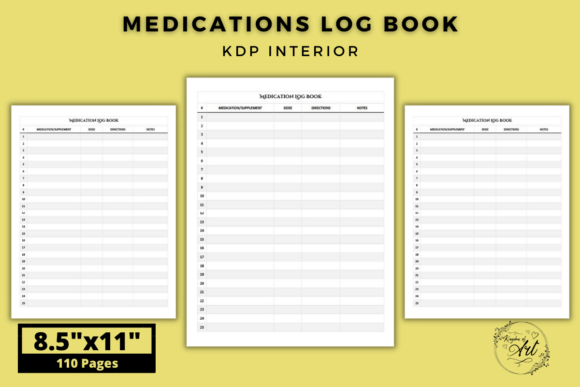
At its core, a Medications Log Book KDP Interior is a ready-to-use digital template designed specifically for self-publishing on KDP. It provides a complete interior layout that a publisher can upload directly to the platform, with no need for additional formatting, bleed adjustments, or page size corrections. The product is delivered as a high-resolution PDF file, set to the standard 8.5 x 11 inch trim size, with 110 pages of blank white paper and black ink. It is print-ready, with no bleed requirements, meaning the publisher does not need to worry about trimming or margin errors during production.
Each page of the interior features a structured table format with seven columns. This layout gives users a clear framework for recording essential medication-related information. While the exact column headers can vary depending on the editable version of the file, the typical structure includes fields such as date, time, medication name, dosage, purpose or reason, notes, and any observed effects or side effects. The table is clean, minimal, and designed for quick, consistent entry.
One of the most valuable aspects of this product is that it comes with an editable file. This allows the publisher to customize headers, add branding, adjust column widths, or include additional instructions before uploading their final version. That flexibility transforms what might otherwise be a generic template into a differentiated product that stands out in a competitive marketplace.
The Convergence of Health Awareness and Self-Publishing
There is a larger story here that goes beyond the product itself. The rise of the Medications Log Book KDP Interior mirrors a broader cultural shift toward personal health management. Individuals are increasingly taking ownership of their medical records, tracking their own symptoms, and maintaining detailed logs of prescriptions and over-the-counter medications. This trend is driven by several factors: the growing complexity of polypharmacy, especially among older adults; the desire for better communication with healthcare providers; and the general move toward quantified self-tracking that has expanded from fitness metrics into medical adherence.
Simultaneously, the self-publishing industry has matured into a legitimate marketplace for practical, niche print books. Amazon alone sells millions of low-content and structured books each year, including journals, planners, log books, and notebooks. The KDP platform has lowered the barrier to entry so dramatically that anyone with a basic understanding of file formatting can publish a book in a matter of hours. What makes the Medications Log Book KDP Interior particularly relevant is how it sits at the intersection of these two trajectories: rising consumer demand for organized health tools and a mature infrastructure for digital self-publishing.
Professionals and entrepreneurs who recognize this convergence can create products that are both useful and commercially viable. The publisher is not selling a template; they are selling the ability for someone else to take control of their medication schedule, reduce errors, and feel more confident about their health routine. That is a meaningful value proposition.
Why People Are Paying Attention to This Specific Format
There are dozens of log book formats available on KDP, so what makes the seven-column medications log stand out? A few distinct factors are driving attention to this specific design.
First, the seven-column structure offers a balance between comprehensiveness and simplicity. A log that has too many columns becomes cumbersome to fill out, especially for someone who needs to record entries multiple times per day. A log with too few columns fails to capture the details that matter for medication management. The seven-column format allows the user to record the date, the time of administration, the exact medication name, the dosage, the reason for taking it, any pertinent notes, and a status or outcome field. This structure mirrors what many healthcare professionals recommend for at-home medication tracking, which gives the product a layer of credibility.
Second, the physical specifications of the interior matter. The 8.5 x 11 inch size provides ample space for writing, especially for users who may have visual impairments or who prefer larger handwriting. The black ink on white paper ensures high contrast and legibility. The 110-page count offers enough room for months of daily entries without being so thick that the binding feels fragile. These are thoughtful design choices that reflect an understanding of the end user's needs.
Third, the editable file component is a major draw for publishers. Many KDP publishers start with a single interior and quickly realize they need to differentiate their listing from thousands of similar products. Having an editable file means they can customize column headers to target specific sub-audiences: a medication log for post-surgery recovery, a chemotherapy medication log, a veterinary medication log for pets, or a log focused on supplement tracking. This flexibility turns one interior into a product family.
Changing Needs and Evolving Workflows
The relevance of the Medications Log Book KDP Interior also stems from how expectations around health documentation have evolved. Not long ago, medication tracking was largely the domain of nurses, caregivers, and institutional settings. Today, individuals are expected to manage increasingly complex medication regimens on their own, often with minimal professional oversight. This is especially true for the growing population of older adults who take multiple daily medications and for individuals managing chronic conditions such as diabetes, hypertension, or autoimmune disorders.
At the same time, there is a broader movement toward consumer-grade health tools that bridge the gap between informal note-taking and clinical record-keeping. People want something more structured than a scrap of paper but less intimidating than a full medical chart. A printed log book provides that middle ground. It is tangible, does not require battery power or an internet connection, and can be brought directly to a doctor's appointment for discussion.
For the publisher, the workflow advantage is clear: produce once, sell many times. Once the interior is designed and uploaded, it can be listed on KDP with no ongoing maintenance. Amazon handles printing, shipping, and customer service. The publisher's role is to ensure the product is discoverable, well-presented, and priced appropriately. This is a business model that appeals to freelancers, part-time creators, and entrepreneurs looking for passive income streams.
Practical Examples of Use and Customization
To appreciate the versatility of the Medications Log Book KDP Interior, consider a few practical scenarios where it becomes a valuable tool.
A middle-aged professional managing blood pressure medication uses the log to track daily readings alongside dosage. They note any side effects such as dizziness or fatigue, which they later share with their cardiologist. The log becomes a data source that helps adjust treatment.
A freelance graphic designer who publishes on KDP purchases the editable interior and modifies the column headers to create a specialized log for post-operative patients. They add a column for pain level on a scale of 1 to 10 and a section at the bottom of each page for weekly summaries. This differentiated product sells well among caregivers looking for a recovery-focused log.
A marketer building a brand around health and wellness products creates a series of log books, all based on the same 7-column table structure, but tailored for different audiences. One version targets parents tracking children's medications, another targets pet owners, and a third targets athletes managing supplements. Each version shares the same core layout but feels unique to its audience.
These examples illustrate how the product is not a one-size-fits-all solution but a foundation for customization. The editable file empowers the publisher to adapt the interior to specific market segments without starting from scratch.
Connecting to Larger Developments in Digital Publishing
The success of products like the Medications Log Book KDP Interior reflects several larger developments in the digital publishing industry. One is the shift from content creation to content packaging. Many successful KDP publishers are not writers in the traditional sense; they are curators and designers who repackage structured information into usable formats. A log book interior is a prime example of this approach.
Another development is the growing acceptance of print-on-demand as a legitimate business model. Early skepticism about print quality and delivery times has largely faded. Amazon's infrastructure has improved to the point where a customer ordering a log book receives a product that looks and feels like a traditionally published book. This reliability has encouraged more entrepreneurs to enter the space.
There is also a noticeable trend toward specialization. Instead of publishing generic journals and hoping for broad appeal, successful publishers are drilling down into specific use cases. The medication log book is a perfect example of a specialized product with a clearly defined audience. It is not trying to appeal to everyone, which is precisely why it appeals so strongly to its target users.
Finally, the emphasis on high-resolution, print-ready files reflects the growing sophistication of the self-publishing audience. Buyers on KDP expect professional quality. They notice blurry text, uneven margins, and poorly aligned tables. A product that offers a polished, no-bleed, high-resolution PDF meets that expectation and builds trust with both the publisher and the end customer.
Final Considerations for Publishers and Creators
For anyone considering adding a Medications Log Book KDP Interior to their publishing catalog, the opportunity is clear. The product sits at a strong intersection of user need, market readiness, and production simplicity. It addresses a genuine demand for organized medication tracking while offering publishers a low-effort, high-utility asset that can be customized and scaled.
The most successful publishers will not just upload the default file. They will take advantage of the editable format to tailor the interior for specific audiences, invest in a clear and descriptive product listing, and use keywords that align with what real buyers are searching for. They will think about the end user's experience and how the log book fits into their daily routine.
The broader insight here is that digital publishing rewards those who understand both the product and the context in which it is used. A medication log book is not just a collection of tables. It is a tool for adherence, safety, and peace of mind. Presenting it as such, with professional formatting and thoughtful customization, is what separates a forgettable listing from a product that resonates with buyers.
In a market where thousands of new titles are published daily, the Medications Log Book KDP Interior offers a grounded, practical entry point for creators who want to deliver genuine value while building a sustainable publishing business.