How a Magic Tricks Log Book KDP Interior Helps You Organize, Track, and Perfect Your Performances
If you spend any time learning, practicing, or performing magic, you already know how fast the details can slip away. The exact angle for a double lift. The specific audience reaction to a particular prediction. The moment a misdirection worked better than you expected. These are the kinds of observations that matter—but they are also the kinds of details that vanish the moment you move on to the next trick. A Magic Tricks Log Book KDP Interior is designed to catch those details before they disappear.
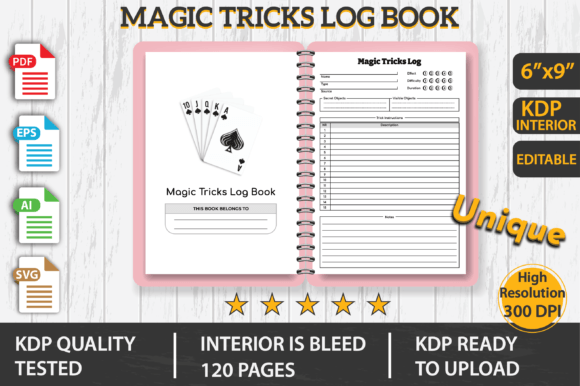
At its core, this is a structured template that turns a blank notebook into a dedicated record for everything related to your magic. It includes sections for trick names, performance notes, audience reactions, practice logs, and space for refinements. The 6x9 inch dimensions (15.24 x 22.86 cm) make it easy to carry in a bag or keep on a shelf, and the 120-page layout gives you plenty of room to log dozens of effects over time. Because it comes as a ready-to-upload PDF with an editable source file, you can adjust the interior to fit your personal style or specific needs before printing through KDP.
A Practical Tool for Magicians Who Treat the Craft Seriously
Magic is not just about learning tricks. It is about building a personal repertoire, understanding how audiences respond, and making subtle adjustments that turn a decent performance into a memorable one. The problem is that most magicians rely on memory alone, and memory is unreliable. You may recall that a certain card force worked beautifully during a living room show, but three months later, you cannot remember the exact wording you used. That is where a dedicated log becomes invaluable.
Using the Magic Tricks Log Book KDP Interior, you can document each trick in a consistent way. You can record the method, the presentation angle, the audience size and demographic, and even the specific environment where you performed. Over time, this creates a personal archive that reveals patterns. You may notice that certain tricks land better with corporate audiences while others work best at casual gatherings. You might discover that your timing improves after a specific warm-up routine. These insights are not obvious in the moment, but they become clear when you review your logs.
Where the Log Book Fits into Real Life
It is easy to think of a log book as something only professional magicians would use, but the reality is broader than that. Anyone who performs magic regularly—whether at kids' birthday parties, open mic nights, restaurant tables, or even just among friends—can benefit from structured note-taking. Consider a few common scenarios where this interior becomes genuinely useful.
- Restaurant and close-up performers who perform the same set multiple times per week and need to track which jokes, pacing, or sleights work best with different groups.
- Event and party magicians who handle corporate gigs, weddings, and private celebrations, where the audience mix changes every time and adapting quickly is essential.
- Magicians who teach or mentor others and want to document nuances that can be passed along to students or fellow performers.
- Hobbyists who perform occasionally but still want to improve between shows, using the log as a practice diary rather than a performance record.
- Content creators and social media magicians who film tricks and need to track what resonated with viewers versus what fell flat.
Each of these users interacts with the log book differently. The restaurant performer may fill out entries immediately after a shift while the details are fresh. The hobbyist may update the log during practice sessions, noting which angles or finger positions still need work. The content creator may use it to track which tricks generated the most engagement and why. The interior is flexible enough to accommodate all these approaches because the sections are designed to prompt useful observations without forcing a rigid structure.
How Different Users Extract Value in Different Ways
One of the strengths of the Magic Tricks Log Book KDP Interior is that it does not assume a single use case. A magician who focuses on mentalism will fill out the pages differently than someone who specializes in card magic or stage illusions, but both will find the layout useful. The trick name field, for example, can also include the source or creator of the effect, which helps with attribution and memory. The audience reaction section can be as simple as a rating or as detailed as a paragraph describing specific comments or expressions.
Some users treat the log as a long-term reference. They go back to previous entries before a repeat gig to remind themselves what worked the last time. Others use it as a live document, writing notes during practice and then reviewing them before a performance. A few magicians use the log to brainstorm variations. They write down a basic trick and then list potential changes to the presentation, the timing, or the prop, turning each entry into a brainstorming session.
There is also value in the act of logging itself. Writing things down forces you to think about your performance in a more analytical way. Instead of just performing on autopilot, you begin to notice small details—the way a spectator's hand moved during a force, the exact moment when laughter peaked, the lighting condition that made a certain prop look suspicious. These observations are the raw material for improvement, and the log book provides a dedicated place to capture them.
Considerations Before You Start Using or Creating Your Own Version
If you are thinking about using a Magic Tricks Log Book KDP Interior for your own practice or if you plan to create one as a product for other magicians, there are a few things worth keeping in mind. First, consider the balance between structure and flexibility. A log that is too rigid may feel like a chore to fill out, while one that is too open may not prompt the kinds of observations that are truly useful. The 120-page layout in this interior offers enough space for dozens of detailed entries without overwhelming the user, but you may want to adjust the number of fields per page depending on your preferences.
Another consideration is portability. The 6x9 inch size is a common choice for notebooks because it fits easily in a backpack or gig bag, but it is not pocket-sized. If you prefer something you can keep in a jacket pocket, you may want to print a smaller version or use the editable source file to adjust the dimensions before uploading. The fact that the interior comes with editable files in PDF, EPS, Ai, and SVG formats means you have complete control over the layout, which is a significant advantage over pre-printed notebooks.
Durability also matters. If you plan to use the log in real performance settings, you may want to print it on thicker paper or add a cover that can withstand frequent handling. The interior itself is designed to be print-ready and has been tested on KDP without errors, but the final quality depends on the paper and binding options you choose. Spiral binding is a good option if you want the book to lay flat while you write, while perfect binding works well for a cleaner look.
Strengths and Practical Limitations Worth Noting
The biggest strength of this interior is its purpose-built design. It is not a generic notebook with a few decorative elements. It is a structured tool that prompts you to record the information that actually matters for improving your magic. The inclusion of a belongs-to page adds a personal touch, and the professional design means it looks good whether you are using it privately or sharing your notes with a mentor or collaborator.
Another strength is the high-quality print-ready PDF. When you download the interior, you get a file that is already set up with bleed, margins, and dimensions that comply with KDP requirements. This eliminates the guesswork and saves a significant amount of time, especially if you are not experienced with print layout design. The tested-on-KDP claim is reassuring because it means the file is less likely to cause formatting issues during the uploading process.
On the limitation side, the interior is designed with a specific purpose in mind, so it may not be ideal for magicians who prefer a completely open journal format. If you like to write long narrative entries or sketch diagrams, the predefined fields may feel restrictive. However, because the source file is editable, you can modify the layout to include blank space, additional note areas, or custom sections that match your personal workflow.
Another potential limitation is the page count. 120 pages may feel like a lot for someone who only performs occasionally, but for regular performers, it can fill up faster than expected. If you log multiple entries per week, you may find yourself reaching the end of the book within a few months. The good news is that the editable format allows you to extend the page count or create a series of volumes if needed.
Beyond the Basics: How This Interior Supports Ongoing Growth
Magic is a lifelong pursuit for many people, and the tools you use should grow with you. A log book is not just a place to store information. It is also a mirror that reflects your progress over time. Looking back at entries from six months ago can show you how much your technique, presentation, and audience awareness have improved. It can also remind you of tricks you have not performed in a while, giving you a reason to revisit and refresh them.
The Magic Tricks Log Book KDP Interior supports this kind of growth by encouraging consistency without demanding perfection. You do not need to write a novel after every performance. A few lines about what worked, what did not, and what you would change next time are enough to build a valuable record. Over the course of a year, those small entries add up to a comprehensive body of knowledge that is specific to your style, your audiences, and your goals.
For magicians who also create and sell their own products, the interior offers an additional angle. It can be customized, branded, and published as a unique offering for fellow magicians. The editable source file makes it easy to add your logo, change the color scheme, or adjust the layout to target a specific niche within the magic community. Whether you sell it on KDP or give it away as a bonus for your students, the interior serves as both a practical tool and a creative product.
Ultimately, the value of a log book lies not in the paper or the design, but in the habit of documenting your craft. The Magic Tricks Log Book KDP Interior lowers the barrier to starting that habit by providing a ready-made structure that is thoughtful, professional, and easy to use. Whether you are performing three shows a week or practicing tricks in your living room, having a dedicated place to record your observations turns experience into insight, and insight into better magic.