Japanese Writing Practice Sheets: Your Path to Mastering Hiragana and Katakana
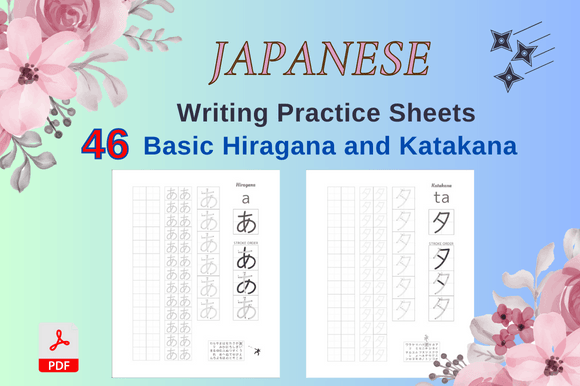
Japanese writing practice sheets are one of the most effective tools for learning the foundational scripts of the language—Hiragana and Katakana. But not all practice sheets are created equal, and many learners pick the wrong resources without realizing how it affects their progress. A well-designed set, like a PDF that includes a clear 3‑page chart and 92 pages of dedicated writing practice for the 46 basic Hiragana and Katakana characters, can save you months of frustration. However, even the best material can lead to poor outcomes when used incorrectly. Let’s walk through the most common mistakes people make and how to avoid them.
Mistake 1: Skipping Stroke Order While Using Practice Sheets
It’s tempting to simply copy the shape of a character without paying attention to stroke order. Many practice sheets show the finished character but omit directional arrows or numbered strokes. Learners then develop sloppy habits, writing characters in an inefficient order that looks unnatural. This doesn’t just affect handwriting; it hinders reading speed and makes it harder to recognize characters in unfamiliar fonts or handwritten notes.
The better approach: Always choose practice sheets that explicitly display stroke order for every Hiragana and Katakana character. If your PDF only shows a static chart, print it and supplement it with a stroke order reference. The best sheets, like those in the 92-page pack, often have dedicated pages where each character appears with numbered strokes. Use these religiously. Start by tracing the characters following the stroke order, then move to writing them freestyle on blank pages.
Mistake 2: Confusing “Chart Only” with Real Practice
A common misunderstanding is thinking that a single chart page is enough to learn 46 characters. Charts are great for quick reference, but they don’t train your hand. Without repeated writing practice, your muscle memory doesn’t form. Many beginners download a colorful Hiragana/Katakana chart, admire it, and stop there. The result: weeks later they still confuse そ and ん, or misremember the Katakana メ and ヌ.
What to do instead: Use the chart pages as a guide, but immediately move to the 92 pages of writing drills that let you practice each character multiple times. Look for PDFs that provide grid lines with correct proportions. The “46 basic Hiragana and Katakana 2” type of PDF usually divides practice into manageable sections—maybe 5–6 characters per page. Work through them methodically. One page per day is far more effective than staring at a chart for an hour.
Mistake 3: Practicing Only Hiragana and Neglecting Katakana
Many learners fall into the trap of believing Katakana is less important because it’s used mainly for foreign words. That’s a costly error. Katakana appears everywhere: restaurant menus, product names, loanwords, and even company logos. If you only practice Hiragana, you’ll struggle to read basic signs or Japanese social media. The PDF mentioned includes both scripts in equal measure—3 pages of chart and dozens of practice pages for each—but some learners focus only on the Hiragana half, ignoring the Katakana section.
How to avoid this imbalance: Rotate your practice sessions. Dedicate Monday and Wednesday to Hiragana, Tuesday and Thursday to Katakana. Use the combined chart to see both scripts side by side. The 92 pages are large enough to cover both thoroughly. Mark your progress on a simple checklist. By the end of the 92 pages, you should have written each Katakana character at least 10 times.
Mistake 4: Using the Wrong Paper or Writing Tools
Digital practice sheets are usually designed for print, but many learners try to use them on a tablet without proper nib or pressure settings. The result: imprecise lines and oversized characters that don’t match the grid. Others print on standard office paper with thin ink that bleeds. This makes it hard to see subtle differences between characters like シ and ツ in Katakana.
Practical fixes: If printing, use at least 80gsm paper and a pen with a fine tip (0.5mm to 0.7mm). For digital practice, use a matte screen protector and a stylus that mimics pencil friction. The grid size in the PDF matters too—check that the boxes are large enough for beginners (usually about 1.5cm squares). If the provided squares are too small, print at 120% scale.
Mistake 5: Rushing Through the 92 Pages Without Review
The PDF offers 92 pages of practice, which is generous. But some learners blaze through them in a week, writing each character only once and never revisiting them. They finish the book but can’t recall how to write ね or レ from memory. This happens because the brain needs spaced repetition to consolidate motor skills.
A smarter routine: Complete one character set (say, あ to こ) over two days. On the third day, revisit those characters without looking at the chart. Write them from memory. Then check your accuracy against the original sheets. The 92 pages are designed to be cycled through multiple times—don’t treat them as a one‑time task. Keep the PDF saved on your device and reprint sections for rapid review once a week.
Mistake 6: Ignoring Handwriting Quality for Speed
Speed comes naturally after correct form, yet many learners try to write as fast as possible to “finish” the practice sheets. This produces characters with unbalanced proportions—like an oversized あ or a か that looks like が without the diacritic. Poor handwriting later interferes with legibility and can even cause miscommunication when writing addresses or names.
Corrective strategy: For the first 30 pages, prioritize perfect reproduction over speed. Use the grid lines to keep character width and height consistent. Compare your output to the example on the chart. If you notice any character looking off, write it five more times slowly. Once your handwriting stabilizes (usually after 40–50 pages), you can gradually pick up speed.
Mistake 7: Not Checking for Consistent Font Style in the PDF
Some free PDFs use quirky handwritten fonts that deviate from standard stroke shapes. For example, the lower part of き may be disconnected, or the loop on の may be too tight. Learners replicate these oddities, then wonder why their writing looks different from textbook examples. The “46 basic Hiragana and Katakana 2” PDF often uses a clear, standard Mincho or Gothic font, but it’s worth verifying before you print.
How to check: Preview the PDF’s chart page. Compare the character め with how it appears in a trusted dictionary or official learning resource. If the shape looks unusual, find a version that uses a standard calligraphic style. The writing practice pages should use the same consistent font for all examples, so your muscle memory builds correct shapes.
Putting It All Together: A Simple Workflow
To get the most out of a Japanese writing practice sheet PDF, follow this cycle:
- Review the chart (3 pages) – familiarize yourself with all 46 basic Hiragana and 46 basic Katakana.
- Write each character ten times using the dedicated practice pages, paying close attention to stroke order.
- Self‑correct by comparing your output to the example. Use a different color pen to mark mistakes.
- Review previous characters every few days by writing them from memory on blank grid paper.
- Repeat the entire process with the Katakana pages, ensuring balanced skill development.
This approach turns the 92 pages into a structured learning journey rather than a passive copying exercise. You’ll build both recognition and handwriting fluency, which accelerates your ability to read real Japanese texts.
Final Thoughts on Choosing and Using Practice Sheets
A high‑quality Japanese writing practice sheet set is a small investment that pays off enormously—if used wisely. The common mistakes of skipping stroke order, favoring only Hiragana, rushing, or ignoring proper tools can be avoided with a little awareness. Take the time to evaluate the PDF you download: does it include clear stroke diagrams? Are the grid sizes appropriate? Does it cover both scripts equally? A resource like “Writing Practice for 46 Basic Hiragana and Katakana 2” with its 92 pages is designed to be revisited, not rushed. Treat each page as a stepping stone, and your handwriting will become natural and precise.