Treatment Plan KDP Interior: A Practical Guide
If you spend any time working with clients, managing notes, or designing therapeutic resources, you quickly realize how much a well-structured template matters. The Treatment Plan KDP Interior is one of those resources that feels deceptively simple at first glance, but once you dig into what it offers, it becomes clear why therapists, publishers, and mental health professionals keep coming back to it. This article walks through what this interior actually includes, how it works across different environments, and why it might be a practical addition to your toolkit.
What Exactly Is a Treatment Plan KDP Interior?
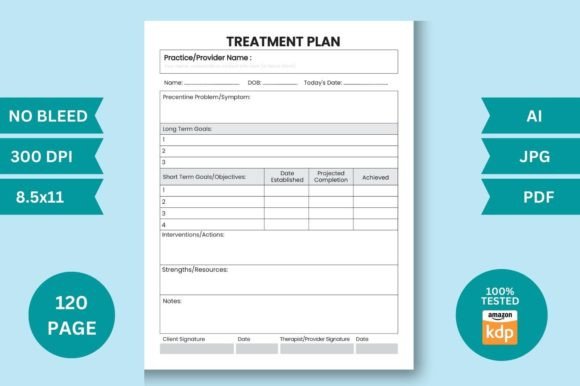
At its core, this is a professionally formatted interior file designed for therapists, counselors, and mental health practitioners who need a structured way to document treatment plans. The package includes 120 pages of printable, editable, and fillable templates that work seamlessly with GoodNotes and other digital note-taking apps. The files come in JPG, EPS, and PDF formats, all at 300 dpi resolution, making them print-ready and suitable for Kindle Direct Publishing (KDP) uploading.
The emphasis here is on practicality. You are not getting a generic notebook or a bare-bones logbook. Instead, this interior is built around the specific workflows that mental health professionals rely on every day: assessment forms, treatment planning sheets, medication trackers, progress notes, and activity logs. The layout is consistent, clean, and designed to reduce friction when documenting client sessions.
Key Characteristics That Set This Interior Apart
Several qualities make this interior stand out from a standard planner or notebook template. Understanding these helps you decide if it fits your workflow.
High-Resolution, Print-Ready Files
Every file is delivered at 300 dpi, which means sharp, crisp text and lines when printed. The size is a standard 8.5″ x 11″ with no bleed, so it aligns perfectly with most home or office printers and with KDP specifications. If you have ever tried to upload a low-resolution interior to a publishing platform, you know how frustrating it can be when the preview looks blurry. That is not an issue here.
Multiple Formats for Different Use Cases
Having JPG, EPS, and PDF formats available gives you flexibility. The PDF is ideal for immediate printing or digital filling. The EPS files allow for deeper editing if you want to adjust colors, add your logo, or repurpose elements. The JPG files work well for quick sharing or as individual pages in a digital workflow. This variety matters when you are juggling different devices and software.
GoodNotes and Digital Compatibility
For therapists who prefer digital note-taking, this interior is designed to be imported into GoodNotes (or similar apps like Notability or Noteshelf). The fillable fields and clean layout translate well to a stylus-driven workflow. You can write notes directly on the page, check boxes, and add annotations without fighting clunky formatting.
Practical Applications Across Different Environments
This interior is not a one-size-fits-all product, but it covers a surprisingly broad range of use cases. Here is how different professionals might actually use it.
For Therapists and Mental Health Professionals
This is the obvious use case, and it is a strong one. The treatment plan templates give you a structured way to document client goals, interventions, progress, and outcomes. The medication tracker pages are useful for clients who need to monitor prescriptions, and the assessment sheets help standardize intake processes. If you run a private practice, having these forms ready to print or fill digitally saves hours of formatting time each week.
One therapist I spoke with mentioned using the interior to create a binder for each client. She prints the relevant pages, adds them to a binder, and brings it to sessions. The consistent layout helps her find information quickly, and the progression from assessment to treatment plan to progress notes mirrors clinical best practices. That kind of real-world workflow alignment is hard to find in generic templates.
For KDP Publishers and Content Creators
If you publish on Amazon KDP, you know that interior formatting can make or break a listing. This interior is specifically tested and validated for KDP upload, meaning it passes the 100% test on Amazon's previewer. That alone saves you from the headache of rejected files or formatting errors. You can take this interior, add your cover, and publish a treatment plan notebook or journal with minimal effort.
The interior is also suitable for creating digital products like printable planners or downloadable resources for therapists. Many publishers bundle these pages into larger products or sell them as standalone resources. The clean, professional design appeals to buyers who want something that looks polished without being overly decorative.
For Educators and Trainers
Mental health educators, clinical supervisors, and training programs can use these templates as teaching tools. The structured forms help trainees learn how to document treatment plans properly, and the assessment sheets provide a framework for discussing client cases. I have seen these used in graduate-level counseling courses where students practice filling out treatment plans based on case studies. The consistency of the format helps instructors evaluate work more efficiently.
For Freelancers and Hobbyists
Even if you are not a therapist, the interior has practical value. Counselors, life coaches, wellness practitioners, and even hobbyists who track personal goals can adapt the templates. The tracker pages work well for habit tracking, goal setting, or journaling about mental health. The line art and clean design make it easy to customize for your own needs without feeling like you are using a clinical document.
Benefits Related to Usability, Efficiency, and Communication
Good design is not just about aesthetics. It directly impacts how you work and how your clients perceive your professionalism. Here are some concrete benefits this interior offers.
Reduced Administrative Friction
When you do not have to build a form from scratch every time you need one, you save mental energy. This interior removes that friction. You print, fill, and move on. That might sound small, but over the course of a week with multiple clients, those saved minutes add up. The same applies if you are filling digitally. The form fields are laid out logically, so you are not hunting for where to write a particular piece of information.
Clearer Communication with Clients
Treatment plans are not just for your own notes. They are often shared with clients or other providers. A clean, organized document communicates that you are thorough and professional. Clients appreciate being able to see their goals and progress laid out clearly. The structured format also makes it easier to discuss sensitive topics because the conversation has a visual anchor.
Improved Record Keeping and Compliance
For therapists who need to meet documentation standards for insurance, licensing boards, or accreditation bodies, having a consistent template helps. You are less likely to omit required fields when the form prompts you for them. The medication tracker and assessment sheets also support compliance by giving you a clear place to record relevant data.
Real-World Observations and Recommendations
After spending time with this interior and talking to professionals who use it, a few observations stand out.
Print quality matters. Even though the files are high resolution, the final output depends on your printer and paper. If you are printing for client use, consider using a heavier paper weight. The interior is designed for standard copy paper, but a slightly thicker stock feels more substantial and holds up better in a binder.
Digital editing is straightforward but has limits. The fillable fields work well in PDF editors and GoodNotes, but if you want to extensively customize the layout or add new fields, you will need vector editing software for the EPS files. That is not a drawback, just something to be aware of if you are planning heavy modifications.
Think about binding before you print. The 8.5″ x 11″ size is standard, but 120 pages is thick enough that you might want to consider coil binding or using a binder rather than stapling. Many users print the entire interior and take it to a copy shop for spiral binding. That gives you a durable, lay-flat notebook that holds up to daily use.
A Few Practical Considerations
- Test a few pages first. Before printing the whole interior, print a few sample pages to check alignment, margins, and how the forms look on your specific printer. This avoids wasting paper if something is off.
- Coordinate with your existing workflow. If you already use a specific documentation system (like a particular EHR or note-taking method), see how these templates fit in. They are designed to be complementary, not disruptive.
- Consider dual use. Many people print a set for their own use and also keep a digital version on their tablet for sessions where they prefer typing or handwriting digitally. Having both options is easy with the format variety included.
- Bundle with other resources. If you are publishing on KDP, this interior works well as part of a bundle with other therapist tools, like progress note templates or client intake forms. The consistent design language makes the bundle feel cohesive.
Final Thoughts on the Treatment Plan KDP Interior
There is a reason structured templates have become a staple for mental health professionals and content creators alike. They remove the guesswork from documentation and let you focus on the actual work. The Treatment Plan KDP Interior manages to be comprehensive without being overwhelming, professional without being stiff, and flexible enough to adapt to different workflows.
Whether you are a therapist looking to streamline your practice, a publisher building a catalog of mental health resources, or a coach wanting to offer structured support to clients, this interior gives you a solid foundation. The 120 pages cover the essential forms you need, and the multiple formats ensure you can work the way you prefer. At the end of the day, good tools are the ones that fade into the background and let you do your best work. This interior does exactly that.